Development of a Square Within a Square (Green), 1999
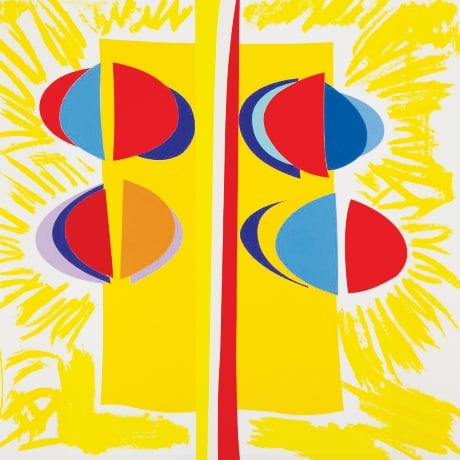
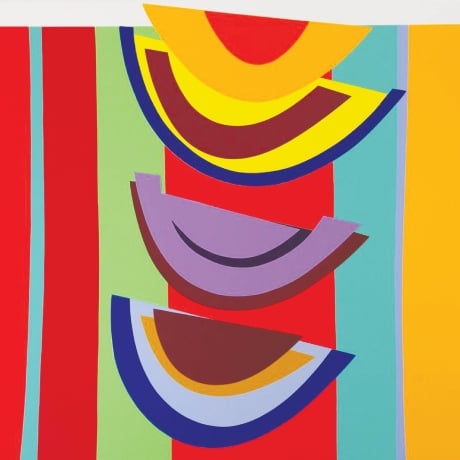
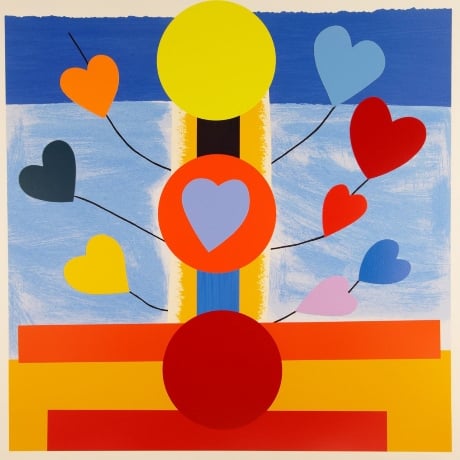
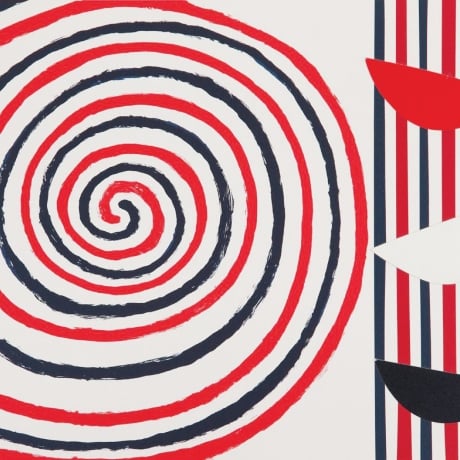
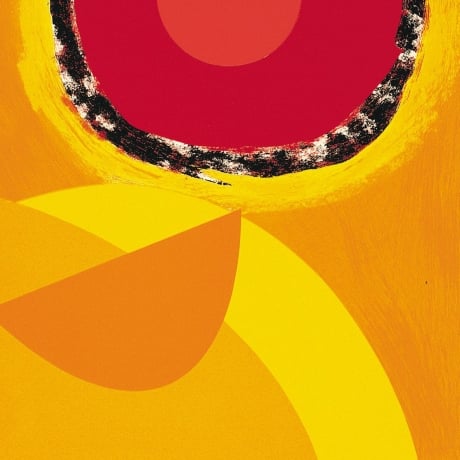
Development of a Square Within a Square (Green) is a signed, limited edition silkscreen print by abstract master by Sir Terry Frost RA.
In this series of works Frost experiments with shape and colour, basing the composition around the colour green. A pale green diamond fills the centre of the image, and Frost bounces irregular semi-circles of red, pink, purple and orange around the edges of the diamond.
Published by CCA Galleries.
Size (cm): 58.5 x 58.5
Any questions? Call: +44(0)1252 797219 or
Contact Us
Specifications
Medium: Silkscreen, Print
Edition Type: Limited Edition
Edition Size: 150
Size (cm): 58.5 x 58.5
SKU: EG22105
Framing
Looking to add a frame?
Many of the prints throughout our website offer the option of hand-crafted framing to complete your artwork. Simply call us on +44(0)1252 797 219 for a framing quote, and we'll handle the rest, delivering your art ready to hang.
Our Framing Service
Our experts will cut, join and assemble each frame by hand to the exact dimensions of your artwork, creating your perfect finished work of art, ready to hang on your wall.
Need Advice?
Some of our framing options may be more suitable for your artwork than others. For expert advice on the best way to frame, give us a call: +44 (0)1252 797219
(Lines open Mon to Fri 9.00am to 5.30pm, UK time)
Your Framing Options at entergallery.com
Box framing is provided with all our online framing, creating a distance between the glass and your artwork, so no risk of ink transfer to the pane. it's the perfect, gallery grade choice for limited edition prints or original artworks.
Shadow float mounting is an option at our website, to give the appearance of an artwork floating within the frame. The mount – an archival foam core – creates depth too, by casting a shadow beneath the artwork. We highly recommend using a float mount when framing artwork with deckled (hand-torn) edges.
As always, all our materials are sustainable and archival to keep your artwork in mint condition and perfectly presented. Simply choose from our white or black float framing options, before adding to basket.
Glazing all our framing orders are shipped with glass. We take great care with packaging to protect your artwork.
Alternatively, for added piece of mind, we've the option of gallery grade cast acrylic, offering superb clarity and protection.
If you would prefer acrylic or other options such as ornate frames or UV protection, please call our gallery team on +44 (0)01252 797219 for a quote, or message us at the bottom right of this page.
Find out more about all our framing options at our framing page.
Shipping
See our Delivery page for full details.
Almost everything ordered through our checkout here at entergallery.com has FREE UK DELIVERY!
Our only exceptions are books, framed artworks, or selected large or '3D' items, such as sculptures. In these cases, a shipping cost applies, with full details provided at checkout.
Despatch Times
Unframed artworks - 10 working days
Framed Artwork - 4 to 6 weeks
Shipping Within the EU and Rest of the World
For deliveries within the EU and Rest of the World, please note the price above does not include local taxes and your order may be subject to import duties & tax, payable on delivery. We have no control over these charges and cannot predict their amount.
About the artist
British artist Sir Terry Frost RA (b. 1915-2003) was a leading figure in British abstract art, and one of the most significant printmakers of the twentieth century. Born in Leamington Spa in 1915, Frost left school at the age of 14 and worked at Curry's Cycle shop and then Armstrong Whitworth in Coventry until the outbreak of war. He served in countries as diverse as Palestine and Greece, before being captured in 1941. Frost remained a prisoner until the end of the war, an experience that changed his outlook on life and introduced him to the possibilities of art. Whilst being held prisoner in Bavaria, Frost began to paint and draw, encouraged by young artist and fellow prisoner Adrian Heath.
He once said: “In the prisoner-of-war camp I got tremendous spiritual experience, a more aware or heightened perception during starvation, and I honestly do not think that awakening has ever left me.” On his return to Britain, Frost moved to St. Ives in Cornwall to be amongst the burgeoning artistic community there. Excluding brief stints in other locations, St. Ives and its local environs was where Frost lived and worked for the rest of his life and his work reflects the inspiration he found in the Cornish light, glittering seas and watery reflections. He attended the St. Ives School of Art before spending 1947–1950 commuting to London in order to attend the Camberwell School of Art. His early work was figurative, but it was the influence of Victor Pasmore at Camberwell combined with that of Ben Nicholson that led Frost to paint his first abstract painting in 1949.
Frost worked as Barbara Hepworth’s assistant in 1951 and had his first solo exhibition at the Leicester Galleries in 1952. Frost taught at many institutions including the Bath Academy of Art (1952–1954), Leeds University (who awarded him the Gregory Fellowship in 1954) and Reading University. By 1960, Frost had his first solo show in New York at the Barbara Schaefer Gallery, and whilst he was there, he met some of the leading American Abstract Expressionists; an experience that soon encouraged him to start painting on a much larger scale. Frost was awarded the John Moore’s Prize in 1965, elected to the Royal Academy in 1992, and granted a knighthood in 1998. A retrospective of the artist’s work was held at the Royal Academy in London in 2000. Frost sadly passed away in 2003 aged 87, but his legacy lives on and his works continue to be a vital part of public collections such as the Tate Gallery (London), the Metropolitan Museum of Art (New York), and the National Galleries of Scotland (Edinburgh).